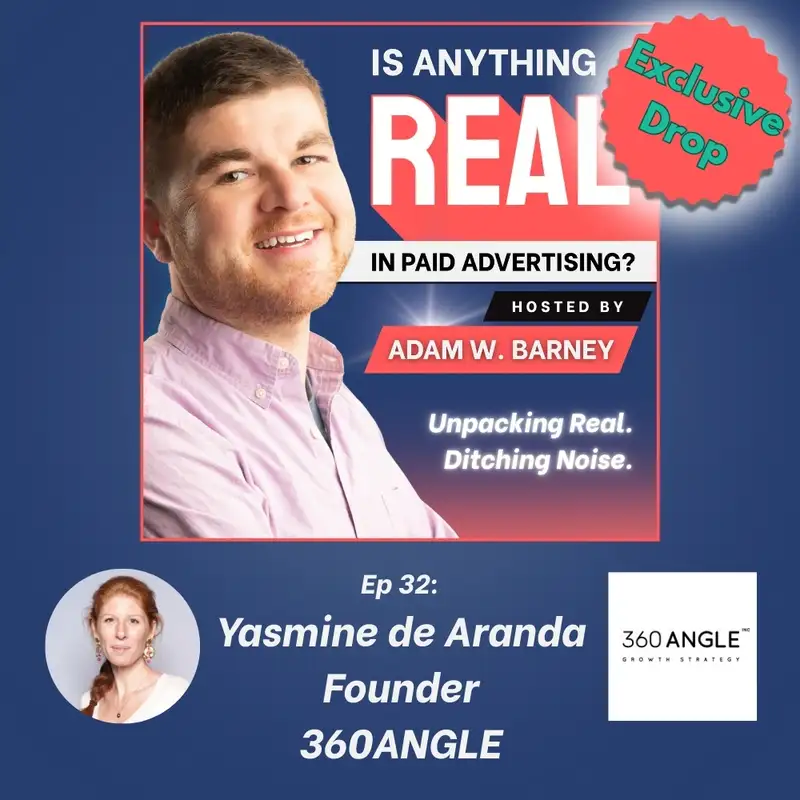
Lead with Humanity: Caregiving, Clarity & Real Growth | Ep. 32 w/Yasmine de Aranda (360ANGLE)
[00:05.6]
Welcome back to "Is Anything Real In Paid Advertising?", the show where we torch illusions and name the BS nobody wants to admit. Here's today's hot take: If your leadership model only works for 25 year old founders with no kids and no obligations, it's not really leadership.
[00:22.7]
It's privilege on parade. Joining me is Yasmine de Aranda, ad world veteran turned founder of 360 Angle, who knows firsthand what it means to lead while raising kids, caregiving for a partner with long COVID, and holding it together for aging parents.
[00:38.9]
Yasmine, welcome to the show. Thank you so much for having me. Thanks Adam. You got it. So I know Yasmine, you and I both escaped advertising's hamster wheel. Why did you trade ad spend for something deeper with 360 Angle? I think it was so intentional to just go a step further in to, to not just, you know, dealing with the ads and being on the outskirts of just, you know, getting people in.
[01:08.0]
The idea was to really look at the entire go-to-market. So really deep dive more into what marketing meant, what the role of marketing was both as a function, so being the glue between the departments, between sales, customer success, product within the B2B tech space, but also I think from a personality perspective it was important for me to also lead by example and leveraging marketing to do that.
[01:38.1]
So by placing, you know, marketing as the glue between the departments and really creating cultures of being in service to. So being in service to sales, being in service to customer success team, being in service to product, meant that marketing could actually do their job better without necessarily burning out by having teams that worked in silos.
[01:59.8]
Yeah, that's incredibly powerful, from a realization standpoint, you know, and obviously again, I know Yasmine, you're parenting two kids, supporting a husband with long COVID and caring for parents. That's the real sandwich generation. How would you say that that collides with the glossy leadership myth that we tend to be sold?
[02:21.2]
I think it's just, you know, I think we get to an age, I mean, I'm in my mid-40s, so definitely the sandwich generation. And redefining what that sandwich generation looks like and how many layers can you actually stick into, you know, stick it to that sandwich just redefines what leadership means, leading with humanity means.
[02:41.4]
And yes, you know, when I say leading and being in service to everyone, it also is about, you know, being able to have the space to build a community, around the family to be able to support humans. You know me as primary caregiver now, and primary providers.
[02:59.2]
So the big myth, or what we've seen at least you know, on the tech side, is a lot of very young founders who you know, are very privileged in that they were able to raise money, they were able to get people, amazing people behind them.
[03:14.7]
But unfortunately, there is a gap in experiences where you know, their reality is that this is their baby. Which, one, it shouldn't be their baby. This is not what a baby is. You have to be detached from your business. And two, you need to be able to really build a culture of, and a safe space.
[03:36.1]
So leadership is not about, you know, having you know, CEO, or COO, or CRO, or CMO. I don't care about your title, I don't care about your position. What I care about is really empowering teams and the people that you hire, intentionally to be able to support them within their journey.
[03:56.8]
So, you can't today expect, you know, to have someone with 25 years of experience and for that person to not be in that sandwich generation. Right. So I think it's just essential to demystify, you know, what founders and startups, myth is of growth at all cost, at the cost of burning through human capital.
[04:21.8]
Right. And you know, I think with, I'm not gonna say age, but with a bit more wisdom. It's really, it's really important to have more clarity on your value system and the principles that define all the decision-making that you need to make as a leader and as a founder.
[04:45.2]
So, I think it really goes hand in hand. It's really, you know, you know, I think we're no longer allowed to look down on whether it's male or female that are caregivers. We're caregivers to everyone.
[05:02.5]
It's not a matter of if, it's a matter of when. The last three years have been extremely intense on our family. My kids are now pre-teens, so at the time they weren't. And I still, you know, it's no longer their primary needs that I have to care for.
[05:21.6]
It's not about, you know, they're able to feed themselves and open the fridge. That's not. But I mean I need to be there emotionally for them. Right. Right. I need to find the space. So my day looks very similar to maybe a founder who's up at 4:30, 5:00 o'clock in the morning and who just gets going and goes to the gym, and goes for a run, and you know, but I mean, my day starts that early because I want to be able, at 3 o'clock when my kids come back from school, I need to be able to be there for them.
[05:48.8]
Right. I, need, you know, able to take my husband to a medical appointment if he has to. Like he's 95% bedbound. So that also has a certain level of realization that I also need to be there for him both physically and mentally.
[06:07.7]
So. Right. You're kind of, you know, waltzing through the life and trying to, to surf, you know, the wave as graciously as possible. That wave of life. And it's not always easy, but it really does take. Very rare are the companies and organization and startups that actually understand that profoundly, not just, you know, that can actually, you know, walk the talk, and not just talk it.
[06:34.3]
So I initially started moving into, you know, the social impact space, thinking, okay, this is going to be, you know, much better. And turns out it's not any better because at the end of the day you still have investors, and you're still accountable, and you know, people will keep on pushing where they can until you're completely out of breath, you're completely exhausted.
[06:55.8]
And the strive for growth and constant growth, is just irrealistic, so. Right. Well, and I mean, I think a lot of what we're covering here, Yasmine, you know, a lot of the companies out there, I'm sure that you and I have even worked for in our careers, but we know more junior employees, they get, they get interested because of the perks.
[07:16.8]
Right. Whether it's a yoga stipend or a, even a value over the last handful of years, of working on personal wellness. Right. That's a piece that's gotten tightly wound in there. But you know, it's really about whether leadership be, whether that counts if it ignores the human load you mentioned that leaders and employees actually carry.
[07:40.5]
You know, and we've lived with that clash. Right. You know, where, where you've got 27 year old founders preaching hustle harder while we've balanced our complex needs as caregivers. What do you think the blind spot is there that they refuse to see, whether it's intentionally or unintentionally?
[08:02.5]
Is it the lack of lived experience with that, or is it something about just the headspace that we work in? I think it's a bit of a mix, and I think it's a lot of it is obviously not understanding firsthand what those deeper responsibilities look like.
[08:19.3]
But I mean, you know, I mean, I've worked with amazing founders who were extremely mature and extremely, you know, in the right headspace. But then what happens is you end up being so much pressured because you have financial strings attached because there's that pressure from investors, and boards and, you know, on.
[08:39.7]
So where are we at? Where are we at? And obviously, you know, the startup grind is real. You're in survival mode. So I think that that also brings out, not necessarily the best out of people. It really, you know, brings out the worst out of them. So I think that even if naturally they're inclined to being more attuned and they're in, you know, inclined to obviously understanding the needs and having that empathy, that empathy erodes.
[09:04.5]
So when results are not showing, and it's not necessarily a marketing issue, this is where, you know, being able to construct and build teams that are really working together and in alignment together, this is what happens.
[09:21.0]
They end up really with, yeah, they end up really completely stretched thin and that's it. The only thing that matters is, you know, are we hitting our targets? Are we able to tell our investors that, you know, we're going to just, you know, be able to bring that return on investment.
[09:41.5]
So yeah, it's definitely that growth at all cost is just, you know, dribbling down. And it creates a lot of stress. And then it creates a different type of hiring. You know, they end up hiring tactically, so they want tactical, tactical, tactical.
[09:59.8]
It's like, hang on a second, breathe. You know, before you have tactics, there needs to be a strategy. There needs to be a business strategy beyond just a marketing strategy. So, you know, I think they get so excited at the idea of tactical, you know, demonstrating that they're moving because tactics show that they're moving, whereas tactics is really probably the noise before defeat at this point.
[10:27.6]
That recruiting juniors, using and leveraging AI, you know, in the wrongest way possible becomes just, you know, like, oh, but we're doing something. So it's like, no, you're not doing anything actually. You're just running faster to your death. Right. So, I think, you know, it's, it really is about finding healthier and creating healthier spaces for everyone to work with.
[10:52.1]
And it really does take, a redefinition of what does success mean, for everyone in the company. There is the business success. But there is also our individual definition of what success means. Right.
[11:07.8]
And you've described those to me as, you know, and I think we're aligned in both my coaching and what you do through, through 360 Angle, but it's about using the tools of self-awareness and emotional intelligence as survival tools and essential in the journey as a leader, the way you lead a company.
[11:25.0]
And it's not, I think you've seen over the last 20 years of how the tech world has evolved leaders work to use that. But that needs to drip down, that needs to ripple down across the organization. It comes down to caregiving is not just compassion.
[11:42.9]
It truly is equity work. Right? It is, it really is. And it's not just about, you know, there is the component of caregiving, which is, you know, the, the physical aspect of the cooking, the cleaning.
[12:00.3]
But I mean, this is, this is minute. This is like, you know, you can hire anyone to do that. This is not what caregiving, you know, should look like. So as soon as you start adding stressors to somebody who's a caregiver, you know, it's really hard to show up as your best self every single day and to be there for everyone every single day.
[12:22.6]
It's a struggle. You know, two days ago was a struggle. Every day is a struggle. You know, you're constantly divided for attention. So it really does take a support network around and it comes with the school friends and the parents of the school friends that create that safe space.
[12:45.6]
But business is such a huge part of our lives that we should be able to feel safe within a business. Right. Not to have to feel like, you know, they're gonna let me go, and they're not being transparent about it. Right. You know, and I know you and I have spoken also to sort of stay in that business realm a little bit, accelerators tend to design what they do for kid free, caregiving free founders.
[13:13.1]
Yep. What do you think we lose there? And I would say there's a spoiler there. It's not just talent, it's wisdom. Totally, totally just the wisdom. And, and I mean, having leaders that are able to create the right spaces for those people to thrive, ultimately, you know, even if you're hiring a bunch of juniors, in five years from now, those, you know, those young people are going to start aging.
[13:37.9]
They're going to be part of their, you know, the sandwich generation. So by being able to show up and demonstrating that you could, you know, you don't need to be an octopus to be able to handle, you know, everything graciously.
[13:53.7]
But leading and paving the way on what, you know, healthy work environments look like is so important. So, yes, it's beyond the wisdom and the experience. It's also, you know, supporting founders. I mean, I've had the pleasure of working for many years with a junior web developer.
[14:12.1]
And she was awesome, but she had decided to marry outside her caste, and she was devastated. And, you know, she came to me saying, you know, that's it. I'm leaving. You know, I'm leaving my family. And I just went, I wasn't prepared for that.
[14:29.1]
You're never prepared for that as a leader. I was, you know, it was 10 years ago, and I said, are you sure this is really what you want to do? Have you even given your parents an opportunity to speak to you about that? And she went, no, but they're never going to accept it.
[14:44.4]
And I thought, okay. I mean, my responsibility at this point. And I was, you know, she was living in India, I was living in Montreal. Right. My responsibility as a leader and as a team lead is not to support that. It's to make sure that I'm asking the right questions to guide her decision so that her intention, you know, her decision is not based out of an emotion.
[15:07.3]
It's founded on, you know, things that are correct. And then obviously, she ended up not leaving the house, and she ended up marrying with the gentleman, having kids, and having her family support that on top of it. So we play a massive. It is our response.
[15:22.6]
It is our social responsibility. It's beyond. It's our social responsibility to show up and to lead by example. Yeah, it's no longer acceptable to just turn our back on everyone because, you know, we don't fit the business needs.
[15:39.0]
It's not acceptable. Right, right. And I know that you were able to build community support around your family when crisis hit for you. Sure. What if workplaces mirrored that instead of hiding behind what I would call either performance or policy binders?
[15:58.8]
That would be amazing, because then you're able to be there everywhere and show up really properly on every side. So I remember the first thing that I, you know, that I ask the companies and the places that I work with is flexibility.
[16:14.4]
I need flexibility. Right. So I think that flexibility is really something that we should be able to trust the employees that we hire and, you know, the contractors that we hire, that it is, you know, it's a relationship that's based on trust.
[16:30.3]
Trust and truth. And we need to be able to trust the people that we hire to do the job. And if flexibility is a key element that is needed for them to be able to strive at work, then let that be it. But there's that projection of, well, if I was in her shoes, I wouldn't be able to do all of that, and you know, I wouldn't be working.
[16:53.7]
It's like, well, you know, my value add is not sitting in front of my desk 9-5. Right. It's way beyond that. And it's incredible. This gets in, Yasmine, to the fact that we're all humans, and we're adaptable. Right. In the situation that we face. What would you say to kind of tease this out a little bit, what do you think the most underrated skill a leader actually gains from being in that caregiving role is?
[17:19.8]
Oof. I'd say empathy times a million. Yeah. I would say it's almost like the true value of how you can operate as a balanced human. Right. Totally.
[17:37.4]
Sorry, go ahead. Yeah, yeah, no, I was gonna say. And you end up, you know, you want to lead from a place of love and not from a place of fear. And then you also realize that by leading out of a place of fear, you never get anything good, because you're not fulfilled, you're not out there.
[17:53.4]
So I think that leading with empathy, but really, I mean, defining empathy, what does empathy look like? And I mean, as a leader, it is so essential to be able to hold that space and to understand intentionally what other people in your team are going through.
[18:13.5]
Yeah, I think empathy is probably, you know, the biggest. I mean, for me. it's also the basis of marketing, of, you know, being able to support the entire business funnel, so the entire customer funnel and user funnel, it is empathy. It is driven in really understanding so profoundly the people that we serve so that, you know, we delight them, we're able to support them, they're able to do their job.
[18:38.9]
It's the same thing. It's the same thing. Like, we should have enough empathy and have, enough humanity to be able to support, you know, everyone that works to support that customer journey. Right. So, yeah.
[18:55.0]
Plenty to unpack there. I have to say that, you know, if you ignore the sandwich generation as a leader, you're not just heartless, you're becoming irrelevant unknowingly or in unintentionally even. Yeah, yeah. And I remember, you know, like COVID, you know, before COVID I used to apologize for having my kids, you know, run to me in the middle of a meeting and I'd be like, trying, you know, to keep them out of the screen and you know, and I, you know, they would come and talk to me, and I'd be like, you know, hang on a second.
[19:26.3]
I'm like, you know, I'm on the phone. I don't apologize for that anymore. This is life, right? On my deathbed, as my husband has, you know, profoundly tried to shape how I think because he's been so much part of that growth journey, you know, it was all about, you know, on your deathbed, is it your customers that are going to say, hey, yes, you know, where were you?
[19:53.1]
Or is it going to be your kids? So, yeah, when I choose to take my kids, you know, when I'm a volunteer at school, so when I choose to do an outing with my daughter because she's going through a huge amount of stress having to deal with her father not being physically in her life on a day-to-day basis, and she needs me to be there and to show up for her.
[20:16.9]
Right. I don't give a flying monkey what's happening. Like, trust me that I have buckled my week and that I am still available in case anyone wants me. I'll never be a bottleneck, but I need to take that time off for her. Right. And this is no longer, you know, whereas I think years ago I would have, you know, always prioritized business at the detriment of the family; now it's the opposite.
[20:43.9]
The priority has shifted. It doesn't mean that I'm working any less, or any harder. I mean, I've invested, you know, probably more in professional development over the last few years than I did on my university years. So, you know, I'm trying like everyone, the intent is there.
[21:04.5]
I'm definitely trying to be and to show up for everyone as best as I can and realizing that impact and social impact doesn't have to be, you know, at a huge million scale. It starts really at those micro interactions that we have with the people that we crossroads with on the street.
[21:25.7]
Those micro interactions mean that I can, I have an opportunity to show up for those people. Right. And you know, if I'm able to demonstrate that I'm leading out of love and empathy and graciously, then they're able to also realize that they can do the same.
[21:42.7]
And I think that this is the snowball effect that we're trying to get to. Impact, for me, was a big realization. Social impact doesn't have to be millions of people. At least, you know, it's not me with a million. It's me one on one. And then those one on one. And like, I think that this is.
[22:00.6]
Such a Yeah. Such a key element. Yasmine, this is so filled with not just fire, but it's that fire of the need for the balance of heart. Right. And that empathy. And that coming from that place of love. We went from ad world detours to caregiving grit, to the uncomfortable truth about equity and leadership.
[22:18.9]
Where can folks find you and 360 Angle? Wow. You can find me definitely on LinkedIn. And you can. So I've got the website up, so it's 360Angle.ca And you can shoot me an email at yasminedearanda@gmail.com.
[22:39.7]
Yeah, I'm really just. Whether it's brainstorming for business, brainstorming personally, or just finding somebody to. Finding an ear to listen. Yeah, I'm here. Awesome. And finally, Yasmine, for the leader listening, who's juggling kids, parents, partners, and bosses who don't get it, what's the one move they should or could make this week to start to shift that balance?
[23:08.1]
I would say sit with yourself and put down what's working for you, and what's not working for you, and what does an ideal day and week look like and what's really missing? I think for me, it was such a realization to say, you know, I can no longer work full-time.
[23:30.8]
for a company. It's just not physically possible to be able to hold everything. But by the same token, you have that huge financial pressure, but nothing is worth. You know, you can't lose yourself. Like, if I collapse, everything around me collapses.
[23:49.2]
I'm not in an opportunity. Like, I'm not in a position to do that. So sit and understand, what does your day look like? How much can you give? And then again, I think with, you know, the beauty of that sandwich generation is that we've got such an awesome database of problem and solution that it takes us really, like a quarter of the time to do something.
[24:11.7]
And just make sure that you're surrounded with the right people and not be afraid of just letting go. It's okay to let go of the people that don't bring you that energy. It's important that we really protect our time. Protect our energy.
[24:27.8]
And anything that's too negative, let it go. It's okay. Nothing is worth it. Yeah. Awesome. I mean, I love talking about energy, because that energy is such a big piece of things. Yasmine, I really appreciate this.
[24:43.3]
Well, thanks for tuning into "Is Anything Real In Paid Advertising?", the show where we sift signal from the noise and torch the fantasies businesses keep selling. I'm Adam W. Barney, and here's the truth; Leadership that ignores caregiving isn't leadership, it's cosplay.
[24:59.0]
Let's stop pretending and start building equity where it matters most. Yasmine, thank you for joining today, though. Thank you so much, Adam.
Creators and Guests