Break the Agency Mold: Right-Sized Teams, Real Results | Ep. 31 w/Jamie Read (BriteBirch)
[00:08.0]
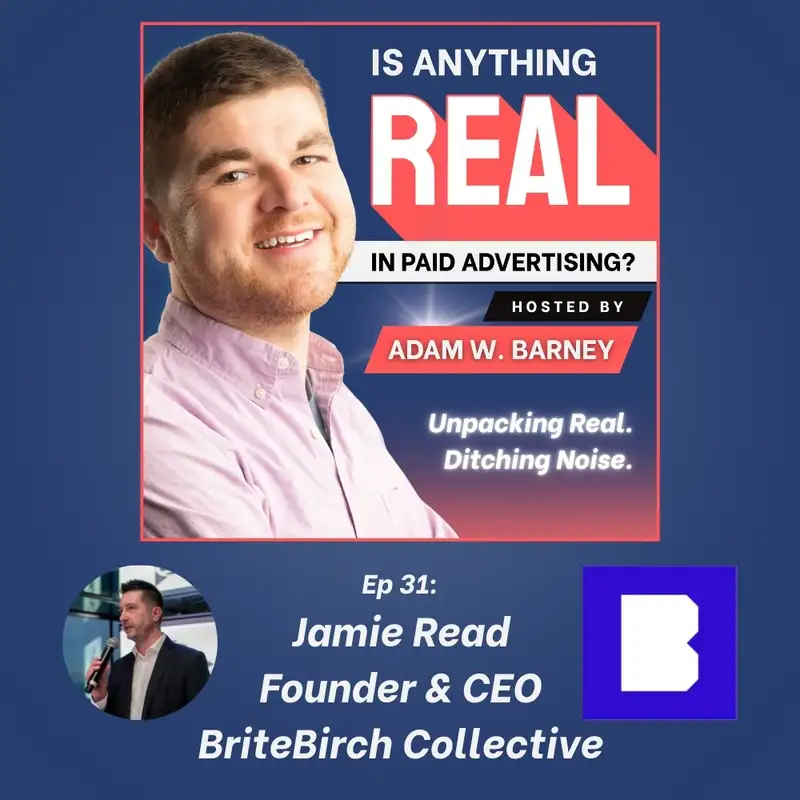
Welcome back to "Is Anything Real In Paid Advertising?", the show where we unpack what's real, what's noise, and what's just another generative AI content mill chasing clicks. I'm your host, Adam W. Barney, and today we're diving into a future facing conversation with someone who's built a global ad agency model that doesn't look or feel anything like the old guard.
[00:30.5]
Joining me is Jamie Reed, founder of BriteBirch Collective. a worldwide freelance talent collective that delivers polished campaign work with the flexibility that modern brands demand. We're talking commoditized paid ads, the AI-driven things we're all facing and why the one to many marketing playbook is fading fast.
[00:51.0]
Jamie, welcome to the show. Thanks, Adam. Great to be here. Awesome. So to start off, you, Jamie, have built BriteBirch to operate as a global network of freelancers with agency polish. For folks who've never seen a model like that, what makes it tick?
[01:07.8]
Yeah, I mean, I think the easy way to explain it is it's sort of like how, you'd imagine The Avengers get pulled together, right? It's like when you are looking for specific skill sets to go after certain problems.
[01:26.1]
Right. There are certain superpowers that work in your favor for certain situations. And so when I used to work in big agencies, it kind of, you know, I always believed in the integrated approach to marketing. You know, it's never just one channel, but when the way agencies tend to be structured is around individual channels.
[01:44.3]
And so, you know, just when, when clients would come to me with a problem, I would always try to think outside of my agency's channel solutions, and try to bring in other players within, whether it's the holding company or, you know, partners for the agency.
[02:01.2]
But it was never as easy as that. And so I was like, there must be easier ways to bring the right talent around the table for clients. It just so happened that I started freelancing and quickly realized, like, this is awesome. You know, I get to set my own timelines, I get to kind of work with the clients I want to work with.
[02:18.0]
But I also found that working for yourself is a bit lonely and a bit, you kind of get stuck in a bit of, you know, clients only know you for like one thing. And so those two problems I kind of saw, like the solution could be by bringing those two worlds together and potentially using, you know, providing freelancers with opportunity to do bigger, better, higher value work than what they are probably doing, on their own at the same time, be able to offer clients the same sort of service and high quality marketing, that is you know, purposely, you know, channel agnostic and purposefully integrated.
[02:57.2]
And really the teams that we're forming are the teams that are needed. It's not who's available, who's billable. It's really about is this person the right person for this job and plug them into a team, that as the team grows, as the project evolves, we can you know, unplug people too.
[03:15.4]
So we'd like to say that we right-size the agency or the solution for our clients so that we're not saying that it's necessarily always cheaper, but you're getting the right people and you're paying for what you get. And it's a lot more transparent than I think a lot of the traditional agencies.
[03:36.0]
Now suffice to say there's still a place for traditional agencies of course, but I just think that this solution is one that's designed more for those mid-sized companies that maybe don't want to spend a fortune on huge big expensive campaigns, but also aren't willing to herd cats through Fiverr and Upwork, and try to try to build their own freelance teams.
[03:56.7]
This is sort of a way to kind of solve their talent issues and challenges while at the same time you know, address specifically addressing challenges through their marketing. That gets into sort of an evolution of the traditional agency structure that I think pieces of the puzzle need to break free from.
[04:16.3]
So that's incredible. I know you've also talked about the sort of anti-fragility of a distributed expert-led team. What does that look like in practice? So what I mean by that typically is just that the world changes too fast, and if you are going to hire a CMO for example, or any C-Suite or senior director-level person within your organization, it's going to be a six month process, at the least.
[04:48.0]
From the moment that you start looking for that job and putting out the job description to the point where that person gets on board, and then it's another six months just to get them up and running. So if you think about just the way that in one year just how much can change nowadays it's almost kind of becoming unfeasible to run a sophisticated modern marketing team by hiring permanent staff.
[05:12.0]
And so what we're seeing is a move towards organizations having their full-time staff. Sure that's not going away, but maybe shedding a lot of the roles that don't need to be full time, always on. But that can maybe bring in the right level, the right expertise and be able to kind of, you know, address that within a day, a week, or within two days a week.
[05:36.0]
And so you're getting higher level talent, but it's much more flexible to fit their schedule, to fit your schedule. And the work that's getting done is project-led. It's not department-led. It's not, you know, if you think about traditional companies in the way they're set up, you know, it's oh, that's a finance problem, or that's an HR problem.
[05:53.9]
Well, if you're the CEO or the board, it's a company problem. And you don't want your organization to be thinking that way. You want to think about. Well, it's not that it's an HR problem. It touches so much of the business. We need HS, of course, involved. Maybe they're leading it, but we need people from all over the organization, maybe outside the organization to be part of this team.
[06:13.3]
And so by building these sort of decentralized, flexible team structures within organizations, they're becoming more resilient to change in the future and to the fact that tomorrow some new AI tool can come out that just basically, you know, just takes over everyone's work.
[06:29.2]
How do you adjust to that? How do you make quick moves to be able to, you know, change your, to pivot, for example, your business. Well, you're going to, you're going to want fractional talent for that. You're going to want to bring in someone that knows your industry, understands where you're going, and then can be brought up to speed on your business in a short period of time.
[06:51.4]
That person with all the tools and resources they need to be successful for you. And you can be, you can do that, you know, with, through BriteBirch, for example, within a matter of a week. So it's the difference between, you know, am I going to take six months to hire that perfect person or can I get that perfect person next week who is already coming with the extended team that I need to do this job?
[07:12.6]
And it's really just sort of building resilience through flexibility. Yeah, yeah. One of the things I'd love to sort of understand quickly also is how you operate not only at that quality level, but maintain that trust, build that process, and keep that excellence high without the usual hierarchy or in-house roles.
[07:34.2]
Because I'm sure some clients that are at the bigger level, are so used to that. And I think we see a lot of people who move from maybe larger companies earlier in their career in marketing into smaller companies over time or growing companies over time.
[07:50.6]
How do you build that trust? How do you make sure that that process is maintained and that level of excellence is consistent? Great question. Look, I think it's not easy for traditional, it's not easy for anybody. One thing I can say though is that, you know, when you're talking about advertising and you're talking about creative work, there's a certain level of craft that needs to be respected.
[08:16.2]
And I think advertisers and marketers that understand the craft are going to expect the quality, and the people that they bring into the team are going to match that level. I think regardless of whether they come from a traditional agency or a freelancer who's working on a project, you're going to want to pick the person that fits your expectations of what good looks like.
[08:40.2]
Now the other thing to consider is that, just like the music industry used to require, you know, musicians to get on big labels so they can go into recording studios and have distribution channels. And there was this whole sort of bureaucracy and procedural approach to putting out music.
[08:59.2]
Now you can do it from your living room in your pajamas, right? You can record, you can, you can edit, you can produce, you can even distribute. And you have all the tools at your disposal. Is the quality of music any worse than it was originally?
[09:15.6]
I mean, audio files might suggest that there is a change. It's become less nuanced, perhaps. But, does the regular listener... I guess it really just matters on perspective, right? And so we're seeing that commoditization and that sort of shrinking of required resources to execute in those kind of creative fields. That happened to photography, right, with, with, different tools and Photoshop and things like that.
[09:43.0]
It's happened in almost every, every, every industry. And so now it's happening in marketing. I love it. You said something previously that's, that really stuck with me. Around how paid media has become commoditized.
[09:58.6]
Can you break down that mindset or that approach or thought process for the listeners here? Again, it's not dissimilar to what I was just speaking about in terms of creative output. I think also in terms of reaching your audience, there's many more tools now.
[10:15.8]
You can use certain tools to post your message across all your social platforms and adjust them through AI in a blink of an eye. I think, you know, in terms of everyone, you know, clients themselves now are pushing back on us sometimes in terms of like, well, why am I paying for someone to run my media campaign?
[10:36.8]
I can do it myself. It's like, yeah, you can do it yourself. So we're trying to educate sometimes clients on like, you know, of certain sizes, like where they can play for themselves and where we can help train them up to be able to do a good job. And so in that, that's what I mean by it's being commoditized.
[10:55.2]
It's really just sort of the sheer amount of tools at everyone's disposal to be able to be found. That is what's really happening is that you're paying to play now, and there's less earned attention.
[11:10.2]
It's mostly all, sort of, being bought. And you know, there's an argument to be said that we're just adding to the noise now. There's you know, this talk of AI just sort of slop, just infiltrating all of our social channels.
[11:25.5]
The Internet's basically just becoming a big slop fest of information. And so I think all of this is part of the same challenge where it's like, you know, you have to pay more now to get even, you know, to get above the noise. And I don't know if that's like a race to the bottom somehow for everybody.
[11:46.4]
One area that I am seeing a lot of interesting change is really in search because you know, where search was monopolized for a while, all of a sudden now people are asking their AI, language models, and different tools for answers to questions that are more specific, which is in fact actually bringing back more earned centric approaches because the most trustworthy news and information is coming from you know, journalistic sources.
[12:15.7]
It could still be a podcast, it could still be other sort of non-traditional channels, but they're still journalistic, in the way that they want to be present the truth, they want it to be earned. It's not a pay for play. And so you know, the AI models are trained to look for that kind of reference, because it's more trustworthy and so therefore it's actually pulling in brands into the search, responses.
[12:39.8]
It's kind of an interesting sort of flip back to sort of why earned is more trustworthy but still not as popular. So there's this really interesting sort of dichotomy always between earned and paid media, and what works better, what part of the funnel it works better at.
[12:56.9]
So I think again, a more multi-channel approach is always the best, to think about where being at the right place, at the right time, for the right price. But that price is what's changing all the time because the access is changing.
[13:12.5]
Interesting. Yeah. I mean I also can hear through what you're saying here, and you know, you've tested plenty of tools. Where would you say the real wins with AI that you've seen in the last year or so are, and where is it still failing marketers?
[13:29.4]
I mean without naming specific tools because like yeah, I've tried many of them. Obviously, you know, the big ones, the most popular ones are the ones that I think are going to kind of win out. But the way that they're being applied has been quite interesting and even within our own network we have a few of our members that have built their own sort of dedicated tools.
[13:54.2]
Some of them are brand specific and like how do you, how do you create new brand, differentiation, and training up AI to really think about where the world's going and how to make sure a company is staying relevant and then others are much more executional in the way that they're using it where it's like, hey, I've got this really great thought leadership piece, turn it into 50 pieces of content.
[14:17.9]
And so it's really going to be a blend, I think, of whatever tools are the most valuable and most useful. Perhaps they're all going to consolidate into one master sort of AI at some point, I don't know. But we are definitely seeing that there's a huge land grab at the moment, and everyone's trying to put out their own AI tools.
[14:38.0]
I sort of personally would rather lean in on the human aspect of everything. Not to say I don't love technology, and I love, you know, I love what I'm able to do with certain AI tools now. But the more that everyone jumps on that bandwagon, the more we can see that there's something lacking.
[14:57.8]
There's some kind of soullessness that is starting to permeate the Internet and starting to permeate our lives. And I don't know, maybe it's just the age I'm at now, the fact I have younger kids and social media. I think more and more I want to go run into the forest and enjoy nature, and I want to talk to people face to face, look them in the eyes.
[15:20.4]
And I think the same goes with sort of the way that we market things. I think more and more there's going to be a bit of a whiplash going back towards what's authentic and real. And so I'm leaning into that, I'm leaning into the human angle of things. Not to say, you know, we do train when we work with clients, all of the body of work that we're producing, and all the research we're doing, it's going into fit to train a dedicated AI that we can turn around and license back to the client after, when we're done.
[15:49.2]
So it's like we're not ignoring this space, but we're not using it as sort of an end-all, be-all to what we're delivering. I'd rather have a sit down and conversation with actual human people, come up with creative solutions, and then look at ways that we can leverage technology to execute. But it's not technology-driven.
[16:06.2]
And that obviously speaks to probably where the most creative, the best creative minds in marketing are heading in the next two to three years as well. Right. But let's say you had to build an attention campaign with zero paid ads, what would be your first move?
[16:25.3]
With zero paid ads, then I would look at sort of PR as being an important sort of step. I'd look at what sorts of platforms can you, can you be invited to that you can, that you can, you know, it really depends on the story that you're telling.
[16:40.5]
Ultimately, if it's newsworthy, then you've got something that's not newsworthy, then you have to make some news. And that can look like all sorts of things. Right. If it's more of a consumer product, you can have an influencer create some noise somehow or you could for example, have an affair at a Coldplay concert.
[16:59.9]
Right. And take advantage of those moments in time. Right. I think that there's going to always be some fortuitous opportunity that comes about, and it's whether you're able to jump on it. Again that goes back to the fluidity of working with our model is we can be much more quick to respond to those kinds of challenges.
[17:22.5]
Turning crisis communications into opportunity is a really valuable aspect of any PR agency or PR expert. But yeah, if you don't have any money, you have to earn it, is probably the best way. Community is another way too.
[17:39.0]
And it's something that we're doing ourselves, with BriteBirch, is we've developed a community for freelancers leveraging the expertise we have with our body of expert freelancers. We see that there's millions of people that are kind of entering the workforce and there's no jobs.
[17:57.2]
So everyone's going to, you know, they have to hustle, they have to work for themselves. But that means that you have to come up with a business idea. You need to find your market, set your prices, figure out your services. Like there's a lot of baseline stuff. And so we want to help that next, that new generation of freelancers.
[18:13.8]
So we built a community called BriteStart, which is sort of a much broader open ended community. That's another way that it's sort of free. I mean it's obviously takes a lot of effort and energy, but it's free to kind of build your marketplace and to build your audience.
[18:30.0]
And so that's another, I guess in a way it's earned also; it's earned through community, but it's a much more authentic way to engage your audiences, and build some interest before you start going out and marketing hard. I'm glad you highlighted BriteStart because I see it there in your tag there at the bottom.
[18:50.4]
That's incredible. Jamie, I have to say this was a master class in terms of what's evolving and what's enduring in marketing today. From the structure of your team to the trust behind every campaign, I think a lot of folks needed to hear this.
[19:07.4]
Where can listeners connect with you or learn more about BriteBirch, and BriteStart, and your work? Yeah, the best way is our website is britebirch.com, that's "BRITE", not "IGHT", just so that it's easier to find, and, you know, BriteStart, similarly, you can find it.
[19:28.8]
We're on Circle. That's the platform that the community is based on. But, if you search it up, you'll find it. Find, us on Instagram and all of those places. But BriteStart is still new and still building, and we're looking to continue to open our arms and invite people who are going off on their own.
[19:48.4]
Then for BriteBirch, I think the sky's the limit in terms of how we can help companies as they evolve. Please reach out and let us know how we can plug ourselves into your teams. Awesome. Lastly, Jamie, for the agency, founder, or brand leader listening, wondering how to stay relevant, what's your one real talk piece of advice?
[20:10.4]
Perspective. It's what our brand is built on. It's the idea behind the fact that we have such a diverse network of experts within BriteBirch. If you're making decisions in a world that's changing constantly,. you're going to likely make a mistake.
[20:27.0]
You're going to get canceled. Even the most recent ad for Levi's, I believe, is being scrutinized quite heavily because of just some choice words. And I don't think the intention was bad, but if they would have just maybe asked a few people who had different perspectives, they may have overcome some of the challenges that they're facing.
[20:48.1]
And then we see that all the time, there's always someone being canceled, there's always someone saying the wrong things. And I don't think that they mean bad by it always, but they just didn't have the right perspectives to help them make the right decisions. So for me, I'd say that's the key perspective. And I think that ties into getting outside of your echo chamber.
[21:06.3]
Right, or your team's echo chamber to get that perspective. And, that's an incredible insight there, Jamie. Oh, I mean, we even have a tool, like if people want to reach out to me, I have a perspective seeking, perspective taking, and measuring the ROI of perspective in building your own business, and how you make decisions and stuff like that.
[21:29.9]
So it's not something that always comes easily to people, but it can be trained, and if you do it purposefully, it can actually help your business quite a lot. That's an incredible resource. Well, thanks for tuning into "Is Anything Real In Paid Advertising?", the show where we find the signal behind the noise.
[21:47.8]
I'm Adam W. Barney, subscribe, leave a review, and check the show notes for much more on both. Jamie, the tool he just mentioned, BriteBirch, and BriteStart, as well. Thanks, Adam. Thanks for joining us, Jamie.
Creators and Guests